

REMEMBERING PANOM

Greetings Everyone,
I’ve switched topics at the last minute. Since this year is the beginning of my 25 years and Counting, celebrating more than a quarter of a century since I came to Thailand to make the elephant film, I’m including in this journal posting an essay I wrote in 2003, which I feel is as relevant today as then. I know…it’s a long one, but I do believe worth the read.
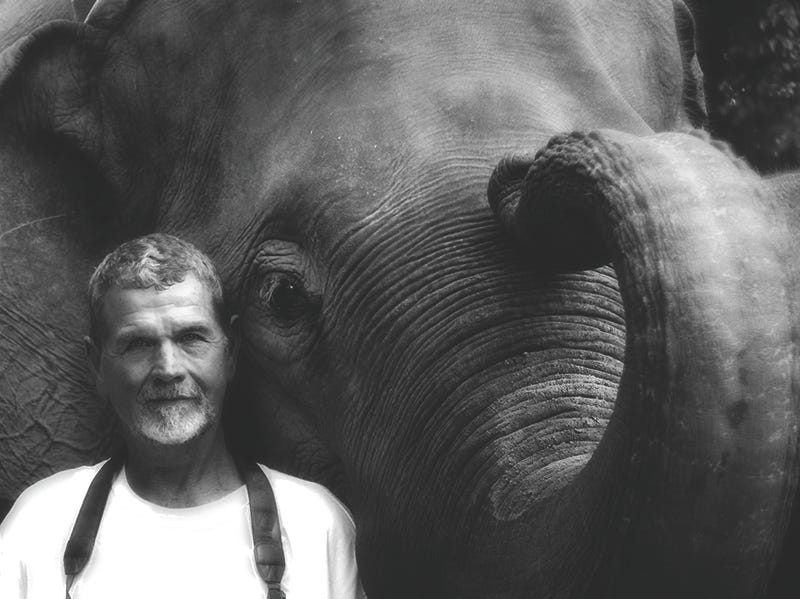
Me and Prathida, ca 2006, photograph by Richard Lair (1942-2024)
DO ELEPHANTS PAINT?
by Galen Garwood
Elephants began their evolutionary history about the same time as humans. Both species probably began as herbivores, but somewhere far back in that implacable flight in which we separated ourselves from other species, we stood and turned significantly toward a more varied bill of fare; we added meat to our diet. While the elephants kept grazing and getting bigger, the two-legged human just got leaner and meaner, and we probably owe our current status as ‘resident bully’ to the enormous caloric barbecues these creatures provided. Between climatic changes and our voracious appetite, the elephant’s ancestors, the mastodon and woolly mammoth, disappeared millennia ago.
This is about when some humans began their profession as painters, the first stirrings of cross-referencing reality. Since no one was keeping records, we can’t know for certain, but it’s believed that cave paintings, such as those in Rouffignac, Altamira, or Lascaux, were highly ritualized pre-enactments of a later, actual event to ensure a successful kill: meat on the table, a brand-new coat, and a bit of jewelry. Nice. And proboscides were at the top of the menu.
In these vast, dark caves of Paleolithic Europe, early man created stunning images of creatures it liked to eat; here too, no doubt, were the beginnings of religion and insurance companies. These primitive images coalesced with objects of fertility; sex, then life, then death, which gave us Egyptian artifacts and Greek statuary, Roman temples, Gothic churches, Michelangelo’s Capello Sistina, the horrific visions of Goya, Monet’s haystacks, Picasso’s bulls, Abstract Expressionism, and the Campbell Soup Cans by Andy Warhol.
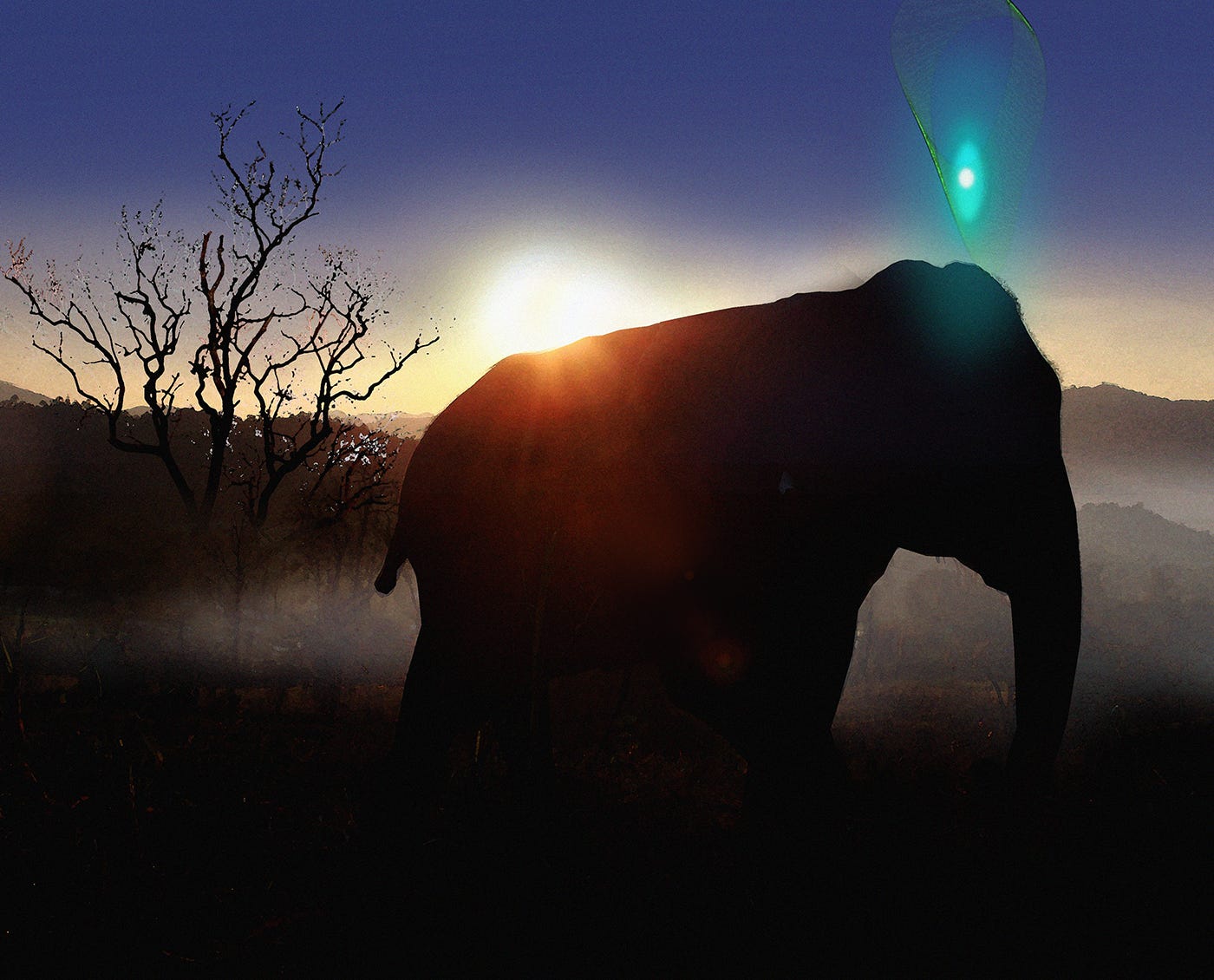
from PANOM, and the Stone of Light, by Galen Garwood, Marrowstone Press, 2011
What were elephants doing all this time to satisfy their artistic spirit? My guess is they bypassed all this convoluted, symbolic ‘stuff’ and simply ate. And they need to. They’re big and terribly inefficient processors of food. A lot of what goes in comes back out with little benefit to the elephant, but with a significant advantage to many other species.
Who has time to think about making art, anyway, when you have to keep packing in kilos of fodder and liters of water? A wild bull elephant can eat, daily, the weight in vegetation of about two humans. Imagine if they were carnivores.
Or perhaps they never had the angst we have, which propels our sense of exigence to create. Though they have every reason to; humans have just about eliminated them from existence. In the latter part of the twentieth century, statistically, one elephant was murdered every hour for a period of ten years.
In the last few years, there has been an explosion of media hype about the newly discovered artistic abilities of elephants. Not only can they paint with the energy and style of a Willem de Kooning or a Franz Kline, but they can also play a variety of musical instruments. Dave Soldier, co-creator of the world’s only elephant orchestra, seems convinced that elephants can extemporize music; he considers this as ‘writing’ music. He believes elephants not only enjoy human music, but they also like to play it. Doing so obviously helps raise money for their upkeep, and Soldier sees no problem with the elephant’s transition from logging to show business.
As an artist, I’ve been very curious about all of this. Also, for the last four years, I’ve been working on an independent film project in Thailand to understand the extraordinary relationship between humans and captive elephants.
I have mixed feelings about the notion of elephants painting and playing musical instruments. On the one hand, elephants playing in an orchestra or painting lyrical abstractions is pure and simple entertainment for humans. Elephants are just one of many animals humans have used and abused long before the Romans perfected the concept of zoos and circuses. One subspecies of the African elephant was driven to extinction by the ancient Roman Empire’s relentless demand for ivory. Palaces were literally constructed from the teeth of these creatures.
On the other hand, where the conundrum really begins to blister, these are human-made projects meant to help captive elephants. The problems these elephants face are not the same as those of wild elephants. Most significantly, you cannot let a captive elephant loose into the wild, even if there happened to be enough ‘wild’ out there. They’ve been bonded to humans. You cannot undo that complicated, psychological relationship without creating additional problems for elephants and humans.
To better understand the painting project and to better filter out my own feelings, I took the opportunity and invitation to work with the ‘painting’ elephants at the Elephant Conservation Center in Lampang, Thailand. This is the group with which Kolmar and Malamid dazzled the public in their highly sensationalized book “When Elephants Paint.” I wasn’t so much interested in when they paint or how they paint, but why would they paint. In other words, do they conscientiously make art the way we do?
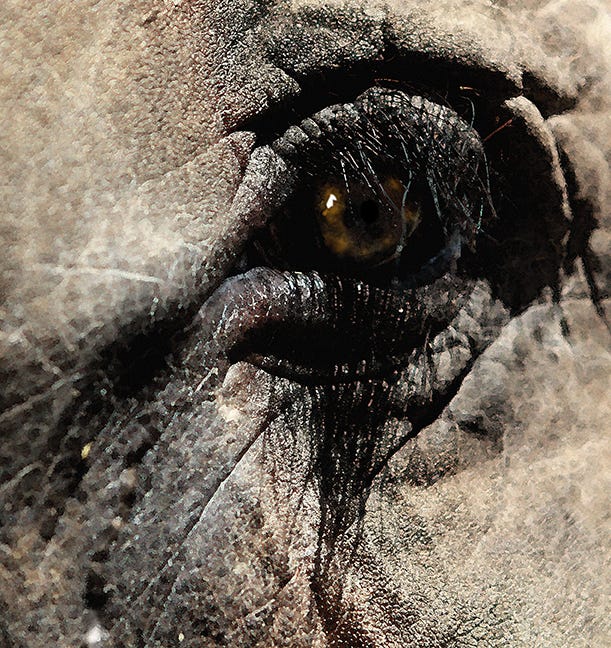
from PANOM, and the Stone of Light, by Galen Garwood, Marrowstone Press, 2011
I found the process to be necessarily and extensively collaborative. My job was to mix the colors and load the brush with pigment for the mahout, who, in turn, placed the brush in the elephant’s trunk. The elephant applies the pigment; the brush is changed, another pigment is selected, and so on. An important part of my job is to indicate when the painting is complete. The mahout often, though not always, influences the actual painting process by pushing the trunk left or right, guiding a tusk, or occasionally using vocal commands.
And yet, it seems the elephant often applies pigment with conscientious determination, and it is obvious elephant painters, like human painters, have their own style. Pong’s interest in creating enclosed, parenthetical shapes has been consistent throughout his painting career, and his stroke application was very different from Wanatee’s Cezannesque. These vertical slashes looked uncannily like the forest in front of her. Some seem to prefer painting more than others, and some seem more gifted. And some, like the charming Prathida, who was once a star painter, find the whole brush and paint thing rather boring these days. He does it, but one gets the feeling that, for him, it’s just another dumb job assigned by the humans. If elephants like to paint because they get bored in captivity, as some argue, then they would easily get bored from repetition. These creatures are made to paint for the tourists twice a day, seven days a week. Believe me, the elephants didn’t sign up for it.
The project I was involved in had nothing to do with the tourist shows but rather focused on producing elephant paintings that are sold on National Geographic’s Novica site. These paintings are done on good paper with quality acrylics. The project has been very successful financially, bringing much-needed income to the Conservation Center. Keeping one elephant is expensive. The Center has over fifty elephants; each elephant has been assigned at least one mahout, who has a family he must feed and clothe. And of course the administrative cost lies above it all.
If I didn’t call an end to the painting, would the elephant continue making the painting as long as it’s given a loaded brush? If so, does this mean the elephant is never given the chance to express itself fully? And would a ‘professional’ elephant pick up a brush and paint even if no human was present? These might seem like ridiculous questions, but are they? Everything is predicated on our sense of aesthetics and our desires, not the elephant’s. We want the painting to look like something that would please us, not other elephants. We have no idea what the elephant is really thinking or what it really wants. Humans have difficulty enough communicating between cultures and races, let alone other species. And, quite possibly, we might not want to know what the elephant is expressing through painting.
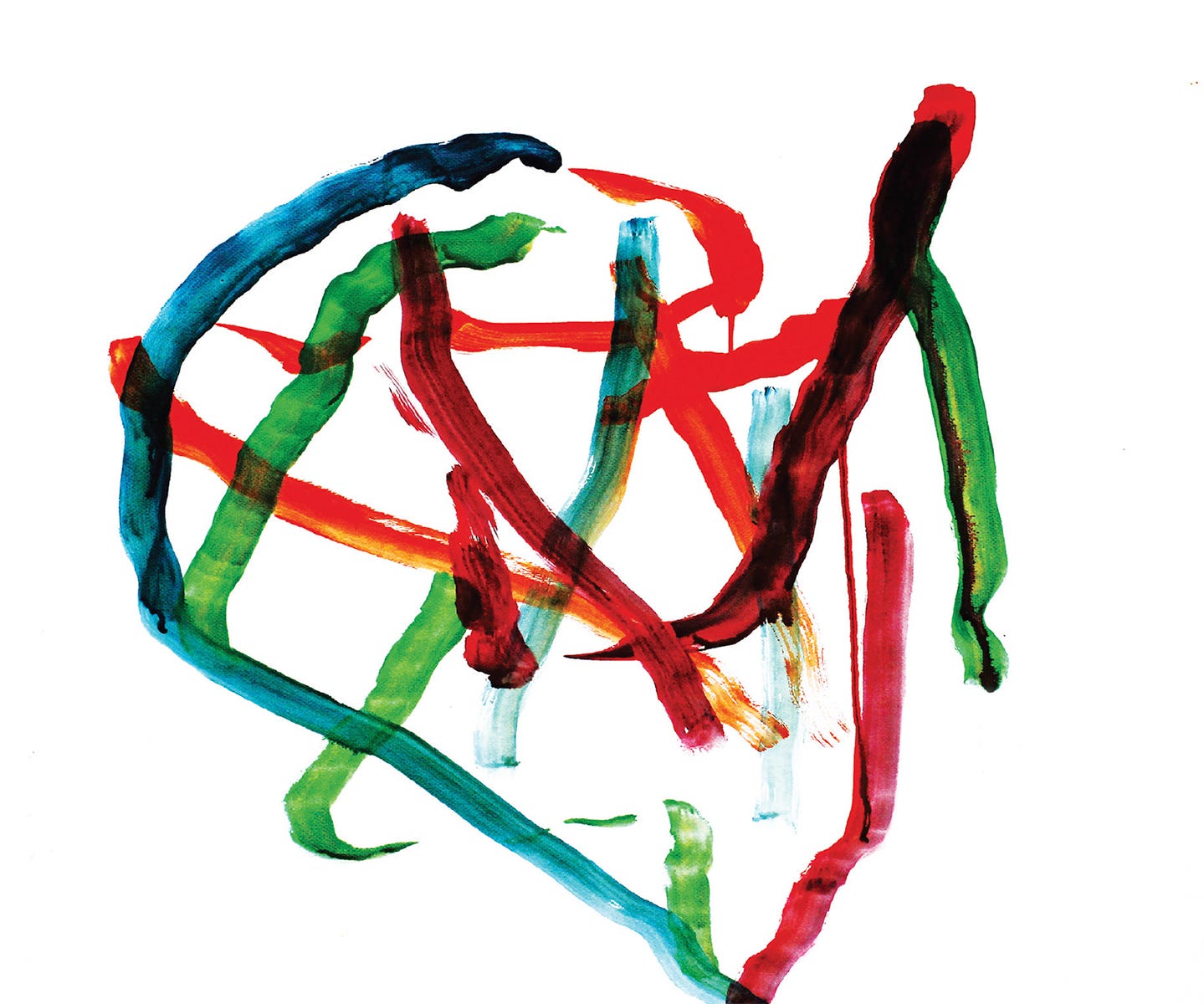
Elephant Heart, painting by an elephant
Ok, you say, “ Lighten up! This project is for the ultimate benefit of the elephants, as they are rapidly disappearing from the planet. There are no real jobs for captive elephants since we’ve over-logged the forest, while at the same time destroying the natural habitat for the few remaining wild elephants. Without tourism to support the relationship between captive elephants and humans, they will surely disappear. Projects like elephant paintings and elephant orchestras keep the public focused on the serious dilemma of the elephant.”
But do they? Is it enough to purchase a CD of an elephant orchestra or a painting by an elephant? Can and should we do more?
Richard Lair, Director of special projects for elephants at the Elephant Conservation Center, believed that keeping elephants in captivity is wrong. After being a beast of burden for well over five thousand years, they remain essentially wild and have never been genetically altered for domesticity. This would seem to make their relationship to humans fairly remarkable. We have bound them to us out of fear, love, and trust. He believes that, sadly, without tourism, there is no hope for the captive elephant. If this is so, it is only a temporary palliative for an alarming problem, not just in Thailand but worldwide and not just with elephants.
I frantically raced between Pong and Prathida, loading up their brushes with the colors I liked because elephants are thought to be colorblind. Since I had two elephants painting, two mahouts assisting, ten brushes bristling, and twenty pots of paint drying, it wasn’t easy to be judiciously aesthetic in determining when an elephant had completed the painting. For me, it hardly mattered. What mattered was being in the midst of their great breathing and quiet spirit; so utterly palpable is the elephant’s place in this world. It’s difficult not to be filled with absolute joy and astonishment when you’re so close to these magnificent beings, and difficult not to wonder what is to become of them. And I cannot wonder that without wondering what is to become of us.
What is it about the elephant that has embedded itself so deeply in the human psyche? Is it because we share many biological and sociological traits, or because we have a similar lifespan? Or that we are prone to suffer many of the same physical ailments, that we have similar familial constructs, or that, as a species, we both can alter the environment in which we live. Perhaps the elephant knows more about this than we do.
Now that I’ve painted with the elephants, have my feelings changed or at least become more focused? Perhaps I should not have titled this essay with the question “Do elephants paint?” A more important question might be: should they paint? But this too is problematic.
We are utterly divided in our thinking about captive elephants. PETA (People for the Ethical Treatment of Animals), by and large a beneficial advocacy organization but often prone to tossing the baby out with the bathwater, would probably consider even the idea of elephants painting as abusive. Completely on the other side are groups like the Feld Corporation, which not only own circuses but also avidly promote elephant breeding programs under the auspices of benign species conservation. They are, in my mind, simply breeding more elephants for entertaining more people to make more money. Floating in the middle are the adherents to the archaic institution of the zoo. Zoos spend a good deal of money trying not to be thought of as circuses, while convincing us how much we need them. We don’t. What we need are sanctuaries for animals that have been kept in cages for too long.
If elephant paintings can somehow temporarily help stabilize the precarious condition of captive elephants, then ok. But it’s a sad fix, and we must be careful. It is all too easy to exploit the elephant, even under the guise of helping it. For well over fifty thousand years, humans have established dominion over these relatively gentle giants. We eat them. We enslave them. We make them entertain us. We demolish their spirit and wear their teeth. During the Vietnam War, pilots were instructed to blow up elephants, lest they might carry some assistance to the enemy. Even today, elephants routinely and inadvertently step on land mines laid by human aggression. We poison, strangle, drown, and electrocute them for encroaching on land, which was once their land.
And yet, paradoxically, we worship them. We love them. What a curious creature is Man. The essayist Loren Eiseley suggested that all species are born with an ordainment of extinction. Maybe the dinosaurs did become extinct due to the cataclysmic collision of an asteroid with planet Earth, and quite possibly elephants will vanish due to the insatiable appetite of an overpopulating Homo sapiens.
And what will become of us, creatures who stood in caves so long ago, making art with one hand and war with the other? While we readily fly the banner of supreme intelligence, we could easily suffer an inglorious disappearance from our own stupidity. I hope not, and I hope, for our sake, the elephants will remain with us; they shouldn’t have to paint to do so.

I am an elephant, grand and gentle, a nourishing concept.
I am a word expressing humility before the generosity of the earth. I am
reflected in every raindrop, a part of every sea,
a mythical matriarch, I am as real as light and nourish the earth,
I am sister and brother to Ganesha, I am
Chaddanta’s sacrifice, a wind of hope upon the land, I am
a collective memory, a dream, a possibility, a vital force. I am
a reason, a cloud of stars, a bridge of hope. I am an elephant.
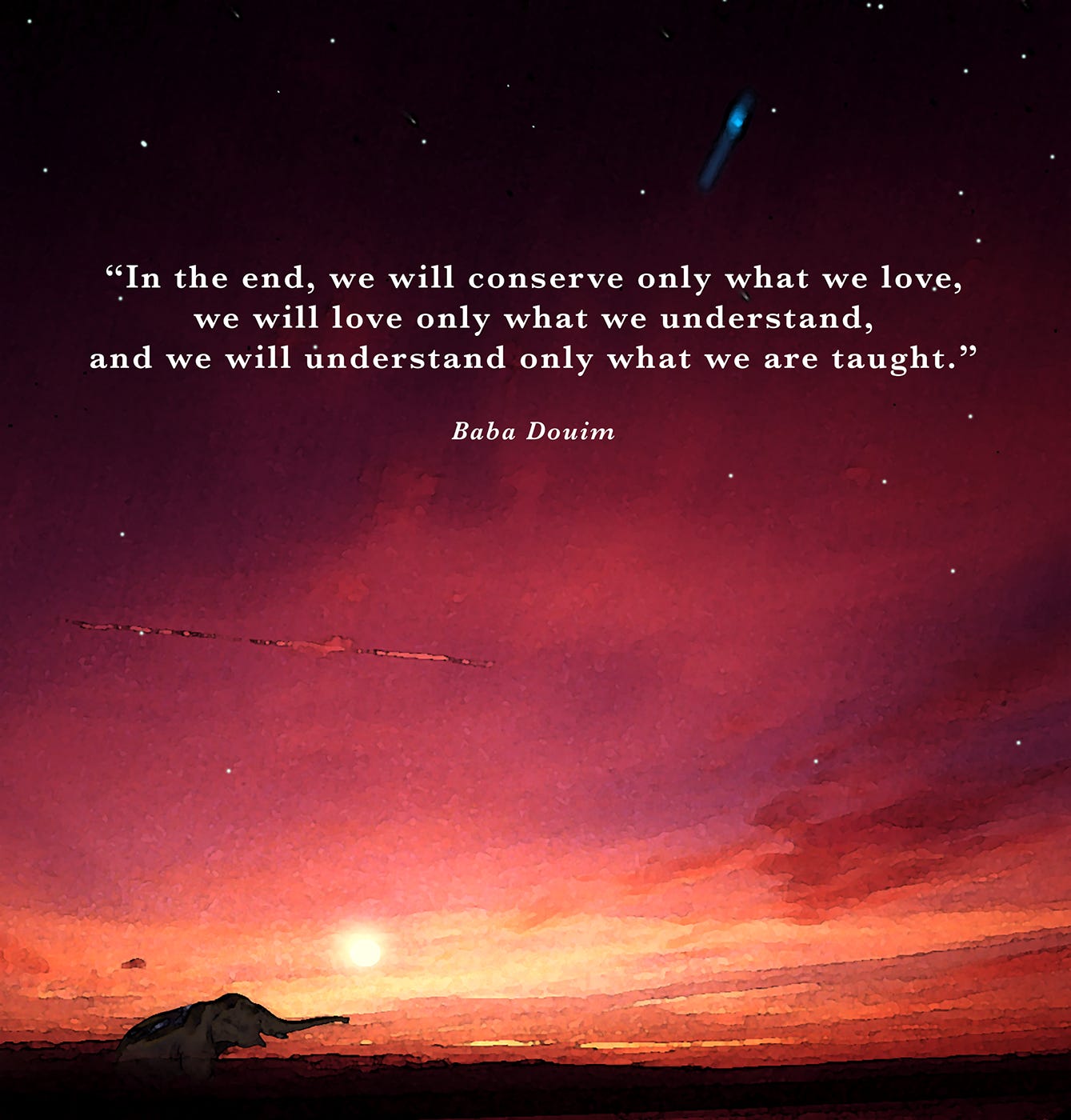
from PANOM, and the Stone of Light, by Galen Garwood, Marrowstone Press, 2011
From Panom, Kados, and me, blessings from the River. Stay strong.
PS: Thank you for your readership and willingness to journey along with me in this mystery we call life.
Greetings Cathy,
Thank you for you comments. I'd not heard about Two Tails. I'm doing fione and I hope to get back for a visit next Spring. Many grand wishes!!
Thank you, Jo, from Panom and me for your connecting spirit!